The moral ambivalence of artistic form
Death in VeniceThe moral ambivalence of artistic form names a paradox at the center of Gustav von Aschenbach’s artistic identity: form can be the achievement of discipline and self-command, yet it can also remain indifferent to moral limits and bend them beneath its authority. In the novel’s account, the very rigor that appears to secure artistic dignity may make transgression more potent, not less. Aschenbach’s career first gives this paradox the shape of a public ideal; his final dream turns it into an indictment of the artist’s passage from beauty to desire.
Form, Discipline, and Moral Exclusion
The idea emerges from Aschenbach’s development as a writer. His early work had unsettled young readers through its radical skepticism about art and artistic ability; his later achievement, by contrast, is associated with a return to moral sternness and a newly discriminating sense of beauty. His style acquires purity, simplicity, and an evenness of attack, qualities that give his writing the deliberate stamp of mastery and classicism. Form, in this account, is not merely a technique: it expresses a life organized around discipline.
That discipline also involves excluding forms of knowledge Aschenbach believes can cripple the will or degrade feeling. The novel connects this exclusion to his rejection of the sympathetic principle that understanding everything means forgiving everything. In his story The Wretch, he repudiates a character who uses psychological profundity to excuse an ethically degrading act. The force of Aschenbach’s condemnation signals a rejection of moral skepticism and fellow-feeling with those who have been engulfed. Yet the apparent moral recovery carries a latent cost: to simplify the world by excluding knowledge may also limit the terms through which its moral complexity is apprehended.
The narrator makes that cost explicit by asking whether ethical resoluteness against knowledge can strengthen a person’s capacity for what is forbidden or morally impossible. The question does not cancel the value of discipline; it reveals that discipline alone cannot guarantee moral safety. Form has two aspects at once. It is moral as the expression and result of self-command, but unmoral, and potentially immoral, because it can be indifferent to morality and make moral judgment yield to its authority. The paradox is structural: formal beauty may arise from restraint without being bound to serve ethical restraint.
Public Mastery and Its Contradiction
Aschenbach’s formal development is reinforced by public recognition. His evolution takes place under the confidence of a large public, and the novel contrasts this celebrated trajectory with the less settled development of a talent outside fame’s entanglements. His later work turns away from abruptness, boldness, and unexpected contrasts toward fixed, standardized, conventionally elegant, and conservative effects. The style’s increasing regularity registers a life that has converted solitude and struggle into power and honor among other people.
That authority becomes institutional. Selected pages of Aschenbach’s work enter prescribed school readers, and he welcomes this recognition as sympathetic to his nature. On his fiftieth birthday, a newly enthroned German prince raises the author of Frederick to nobility. His name is knighted, his reputation becomes official, and boys are urged to pattern their writing on his style. The public image that results is one of artistic discipline made socially exemplary: form is not only personal mastery but a model presented to the next generation.
The novel makes this honor part of the contradiction rather than a resolution of it. Aschenbach has built a reputation by rejecting moral laxity and giving form the dignity of restraint; nevertheless, the later revelation of his desire shows that public standing cannot certify the moral soundness of the artist. The gap between the exemplary author and the man drawn toward forbidden passion gives the concept its dramatic force. Form can confer authority, but authority is not proof that desire has been mastered.
Beauty as a Perilous Road
In Aschenbach’s final dream-logic address to Phaedrus, the paradox is stated as a theory of artistic life. Beauty is described as both divine and visible, and therefore as the sensuous road by which the artist approaches the spiritual. But this road is called pleasant and perilous, potentially wrong and sinful: the artist’s pursuit of spiritual meaning through sensation exposes the artist to misdirection rather than guaranteeing elevation.
Aschenbach’s speech identifies Eros as the guide who accompanies poets along that road. Passion becomes their exaltation, while their desire must remain love, at once their pleasure and their disgrace. He then overturns the public image of the dignified artist: poets cannot claim wisdom and dignity simply because they possess mastery of style, renown, honor, or the public’s confidence. Those signs of authority may coexist with a natural leaning toward the precipice. The speech makes artistic prestige precarious precisely because the artist’s means of access to the spiritual is bound to sensuous desire.
The critique also turns against knowledge. Aschenbach describes knowledge as capable of understanding and pardoning without reserve or form, and calls it sympathetic to the precipice. He resolves to abandon it and to value beauty through simplicity, greatness, new rigor, form, and a second kind of openness. But the reasoning does not end with a secure defense of formal rigor. His next turn is a recognition that form and openness, too, lead to intoxication and desire, and can lead the noble into sinister emotional revels that their own beautiful rigor rejects as infamous. The artist cannot force himself away from this danger; in the dream’s formulation, he can only let himself out.
The Final Exposure of the Paradox
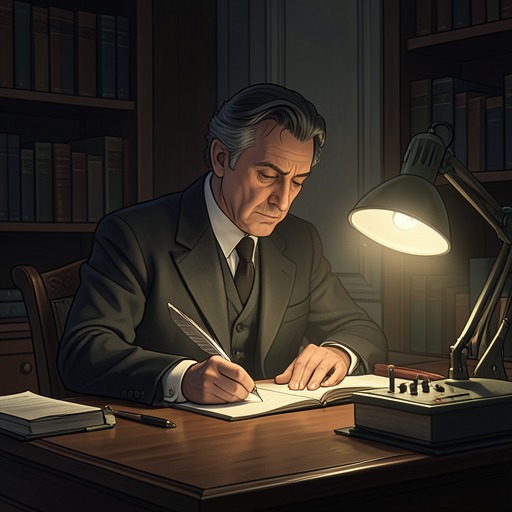
The dream’s formal argument becomes more pointed because the man voicing it is the celebrated author whose career seemed to refute it. Aschenbach sits as the dignified master, the author of The Wretch, a work that had renounced vagabondage, denied sympathy with those engulfed, and cast out the outcast. He is also the artist who has supposedly conquered his own knowledge, outgrown irony, and accepted the obligations of public confidence. His reputation is official, his name has been knighted, and young writers are told to follow his style. Against this record, the dream’s claim that mastery and honor may be a farce sounds less like an abstract proposition than a collapse of his own self-image.
His appearance further sharpens the contrast. His eyelids are shut, an uneasy, mocking side-glance occasionally escapes them, and cosmetics set off his loose lips as they form fragments of the dream’s argument. The man whose art stands for controlled form is speaking in a half-slumbering state, where an unstable chain of ideas carries him from beauty to Eros, from knowledge to the precipice, and from formal openness to intoxication. The dream does not simply declare that form is corrupt. It shows how the ideal of form can be recruited into a self-justification that exposes its own limits.
The concept therefore holds together two truths that Aschenbach’s public image cannot reconcile. Artistic form is a real achievement of discipline, capable of giving experience simplicity, rigor, and shape; yet it does not make the artist immune to desire, nor does it necessarily submit desire to moral judgment. By making the disciplined master articulate how beauty and rigor can lead toward the precipice, the novel turns his career into evidence against the belief that aesthetic control is equivalent to ethical control. The danger lies not in form’s absence, but in the possibility that form’s authority can coexist with, and even lend dignity to, a transgression it cannot contain.